

Battlestar Galactica is a card and board game in which 4-6 players team up to save humanity by winning the game. Some of the players are not human though, they are infiltrating Cylons who are out to sabotage for the human players so that they will lose; their goal is to exterminate humanity.
Character
Cards:
Each player
starts with choosing a character card based on a character from the TV-series,
each character has two positive abilities, of which one is an action that can
be used only once per game, and one negative trait. Each character also has a set number and types
of skill cards that they are to pick up when it is their turn, these are
correlated to which category the character belongs to.
The
personal traits can affect the other systems in many ways, for instance that
there is one character that has to choose the first option of a crisis card if
it is their turn and another character that can steal “miracle tokens” from
other players, allowing them to use their once-per-game-abilities more than
once and preventing the other player(s) from using theirs.
There are
four categories of characters: pilots, politicians, military and support, the first
three players must choose one of the first three categories and may not choose
from the same one as there has to be at least one of each in the game. The rest
of the players may choose freely which type of character they will play. The highest
ranked player in each category receives a title of President, Admiral or CAG
which gives them the responsibility of making certain tough decisions during
the game – for instance there may appear a crisis where the president has to
choose between either executing another player or losing all their skill cards,
which might make the game more difficult to win.
Loyalty
Cards:
Each player
is then given a loyalty card stating that they are either human or Cylon, the
loyalty card is to be kept secret from the other players. This loyalty system
dictates whether you are playing to win or “lose” and urges the players to team
up with each other. The Cylon players may at any time choose to reveal their
identity and use an ability that is stated on their card, for instance to send
another player to the brig.
When the game is half-way through, when the Galactica has reached 4 distances, each player is given a second loyalty card. This means that there may be two or three Cylon players in total adding to the tension and build-up of the game.
When the game is half-way through, when the Galactica has reached 4 distances, each player is given a second loyalty card. This means that there may be two or three Cylon players in total adding to the tension and build-up of the game.
The loyalty
system divides the players into teams, but unknowing of which player has which
loyalty the players are occasionally forced to work together to reach their
goals.
Skill
Cards:
There are
five types of skill cards: Politics, Tactics, Leadership, Piloting and
Engineering, what kind of cards each player can pick up and use is stated on
their character card. There are a few exceptions where players may pick up
cards of other colours than their own though. These cards are spent to perform
actions when it is a player’s turn and to pass(/not pass if you are Cylon)
skill checks.
Crisis
Cards:
At the end
of each turn, with exception from revealed Cylons and players in the
brig/sickbay, there a crisis will occur. The current player will draw a crisis
card which may have a choice for one of the leaders to make, a choice of two
evils and/or skill check or a regular skill check. Some crisis cards have symbols on them that can activate for instance jump preparation or enemy ships when they are drawn.
Resources:
One of the
lose criteria is to deplete one of the resources which are food, fuel, morale
and population, they can be both gained and lost by for instance performing skill
checks. There are also resources in shape of space ships, both humans and Cylons
have a few different types of ships that have varying damage and hitpoints.
The human
ships can only be controlled by a pilot character, either by them launching
themselves into one or by going to the control room and sending them out from
the reserves. The ships can either be waiting in the reserve area, in the
damaged aircrafts area or be completely destroyed and taken out of the game.
Enemy ships
are either activated by certain crisis cards or by a revealed Cylon player
using their turn to build and activate ships.
Locations:
There are a
number of locations on the board, each has their own action that players
currently in them can choose to activate upon their turn. For instance a player
in the brig might initiate a skill check so that they can be freed. Human players can only move between locations on human ships while revealed Cylons only can move to locations on Cylon ships.
Skill
Checks:
A skill
check is prompted either by a crisis or by a player triggering a location, this
means that the players will need to spend skill cards of the corresponding
colours to pass it. All cards are placed face down, together with two random
cards from a destiny deck (2 skill cards of each type) to make it possible for
Cylon players to sabotage and keep their identity secret. Cards of the wrong
colours will count as negative points and the players must reach a certain
amount of points to pass the skill check.
Destination
Deck:
A set of
cards used by the Admiral when the Galactica has performed a jump, the Admiral
draws two cards and chooses which one to use and the Galactica will move the
number of distances that is stated on the card, in order for the players to win
they must reach 8 distances and perform another jump.
Jump Preparation:
To win the game the Galactica needs to perform jumps to evade the Cylons, in order to do this the players need to move a token five times on the jump preparation field of the board. The jump preparation is activated by symbols on certain crisis cards.
Boarding
Party:
One type of
enemy ship drops of a boarding party, if they move four times and reach the “humans
die”-square, the game is lost.
A typical round:
The current
player picks up the amount of skill cards that is stated on their character
card, then they may choose to move to a location and/or perform an action or
play a skill card. When the player’s turn is up or they feel that there is
nothing that they can do, they will draw a crisis card.
If the card
consists of a skill check, two cards from the destiny deck is placed on the
board and players have the option of playing cards that will affect the skill
check, for instance adding an additional colour as a positive, before the
player to the left of the current player starting to place cards on the pile.
Here
players have the opportunity to either help or sabotage for the team or a
player that they might be suspecting is Cylon or human (depending on their own
loyalty). When all players that wish to/can, has spent their cards, the sum on
them is totalled. The skill check is then either passed or failed and the
players will have to take the consequences. When that is completed the player to the left
will start their turn.
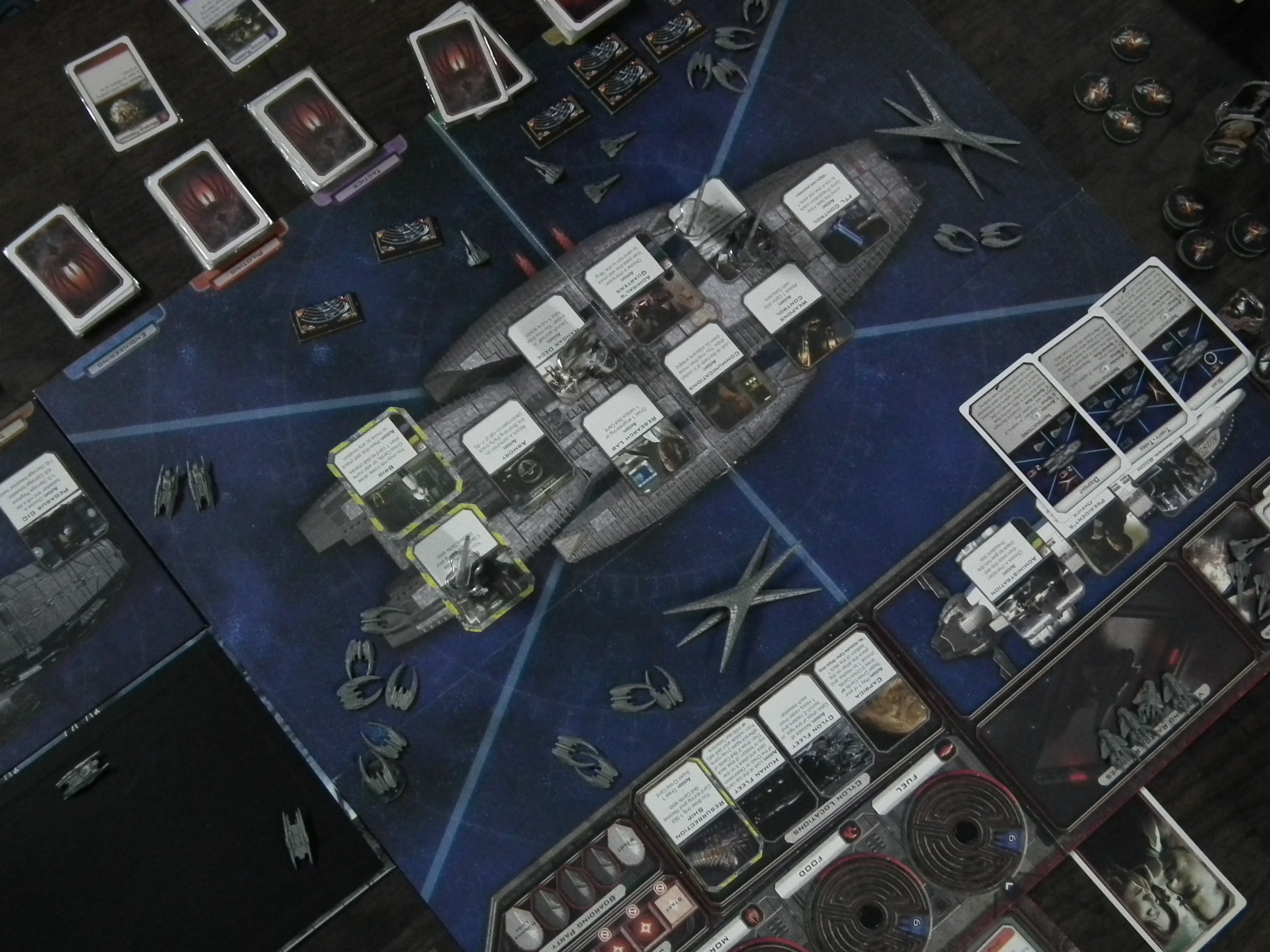
What is the best and the worst parts of the
game?
After
playing the game a few times we came to the conclusion that the best and worst
sides to the game are closely linked. We felt that the best part of the game
was the build up towards a climax at the end, while the worst part was the
anti-climax that was the end of the game. As the game progresses and the
inevitable doom comes nearer and nearer the game felt as if it was building up
towards a dramatic end with lots of tension and excitement. In the end however,
it culminated into practically nothing more than an “oh, we lost”, there was no
real sense of winning either (something interesting to consider is the fact
that every time we played the humans lost). At one time those playing humans
got a card with a choice of dying by losing 1 morale or one fuel, at that point
there was no possibility for them to regroup and win, although the “teams” were
neck and neck.
As said
previously, the build-up was the best part; the human players would try their
best to survive, while the Cylon players would try to sabotage and make the
other players lose. There was a tension created by the enemies constantly
closing in, increasing in numbers and the resources depleting at an increasing
speed. Knowing that someone is an infiltrator but not whom and that there is
not really anything you can do about it, as well as being the infiltrator
trying not to be discovered while doing as much damage as possible was also a
big part of this.
What is the most interesting system?
Our group
was a bit divided when we discussed what was the most interesting system of the
game; one member who had played the game a lot before felt that it was the
loyalty system, while the players who had never played before did not feel as
if it was something we had really used when playing.
Some of us, myself included,
felt that the most interesting thing was the social interaction that the game
created, the loyalty system was though a part of this. Why we felt that this
was so interesting was that it was very very subtle and different from other
games we had played. It was a major part of the game although it did not create
a witch hunt or create extreme paranoia, the game forced the opposing sides to
work together while trying to evade/sabotaging for the others.
Unlike other
games, e.g. the game where someone is a police and another is a murderer that
blinks at its victims, the game did not focus on trying to find out who was the
Cylon, even though it felt as if it composed a major part of the gameplay.
What is the target group?
I would
think that the main target group of the game is the fan-base of the TV-series,
as a way of getting more money out of the brand. The box states that the game is for player of 13+
years old, I do however believe that the target group is somewhat older due to
the complex systems and the political drama of the TV-series.
Although a
thirteen year old might be old enough to comprehend and play the game I feel
that the game is probably aimed towards an agegroup of 15-20 years old, both
male and female Sci-Fi and Battlestar Galactica fans.
It is an enjoyable game
that we had a lot of fun playing, so I think that the game could be appreciated
by a large group of people. The game is however very much based on the
TV-series and I fear that it might scare away players who have not watched it
and might not understand and appreciate the game enough to truly enjoy it. Had
not one of our group members watched the TV-series, we would probably not have
understood the game as much as we did and I do not think that we would have
been able to experience the complexity and depth it offers, therefore I come to
the conclusion that the target group is fans of the Battlestar Galactica
TV-series.
Conclusions:
What most
of us felt was the most interesting thing about the game is how the many small
elements creates the great complexity that the game consists of. Especially the
subtlety of the loyalty system, there was no individual part of the game that
overpowered the others and it felt as if everything was meant to be together. When
playing it felt different from many other games in this regard, the beautiful
subtlety that composes the game felt very refreshing to us and was a major
contributor to why we enjoyed the game so much.
Some parts
felt a bit redundant though, as if they had put it in the game and found
something for it to do just because it was in the TV-series, although it did
not at all add to the gameplay. The boarding party is the most prominent
example of this, as it seems very ineffective and played almost no part in the
game. Only two or three times did we use them in the game and they never made
it further than one or two steps even if we mostly just let them be, that is
what made it feel as if it was there only to give the ships that drops them off
a reason of being there, other than they exist in the TV-series. This is strange
however, since them moving four times is one of the loose conditions.
The ending
was, as said earlier, a bit of a let-down, the build-up promised so much but it
did not deliver. It is something that could have profited by more playtesting
and balancing to make the ending feel as dramatic and climactic as it was
expected to be.
We enjoyed
playing the game even though most of us had never watched the TV-series, but I
do not believe we would have had the same experience if not one of the group
members new both the show and the game very well. I believe that it is very
much adapted to the TV-series and that it might alienate potential players that
are not fans of Sci-Fi or the series, which might otherwise have really enjoyed
the game. It could be considered a strong point though, that it is very much
targeted at a specific audience.
